
When we say of something which encounters us that it is this, are we saying anything about the thing itself at all?’[1]
Martin Heidegger began from the centre – he had little choice. Navigating between ‘this’ and ‘that’ cleared a route for the vessel of existential phenomenology. The privileging of singularity, of being as an interrogative state, effectively conceptualized zones of distance and proximity, emphasizing the human subject’s ability, and drive, to name objects, to better substantiate the real. Today, these identifications somehow fall short of knowledge apprehension; encountering a thing, as a subject, inevitably demands its objectification or, a supplementation to whatever it is that has been placed before us. A name might qualify a thing, but it cannot quantify it. For Graham Harman, this earlier problematic, caught up as it was within a philosophical tradition, has been widely underestimated in its ability to discover crucial questions for an object-oriented ontology. Heidegger’s ‘theory of objects’ still permits us to explore ‘the difference between the unitary system of being and its fragmentation into various objects [my emphasis].’[2] Moreover, by inhabiting such a question from what have since emerged as the limitations of humanist discourse, a post-human articulation of (im)materiality has indeed become possible.
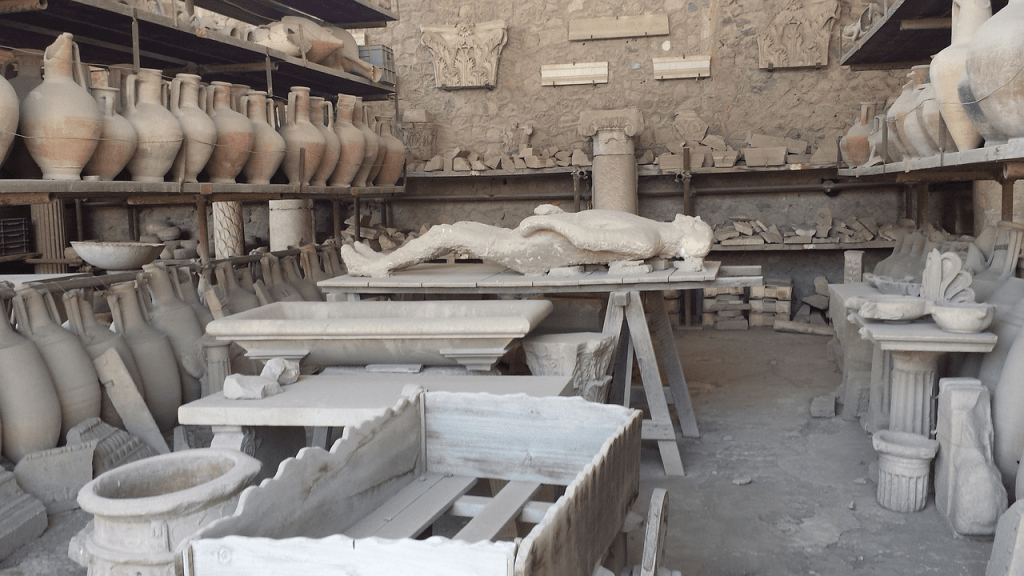
I will never forget my first visit to Pompeii, to that chamber in which that one petrified body rests in permanent stasis among so many other artefacts and fragments, reliquaries of lost experiences, an object that is somehow a familiar destination but also emblematic of a most foreign realism. Following Heidegger, it could be said there is a duality at work within this thing; it brings one face to face with a fully subjective experience – that finality we call ‘death’ – along with the certainty of the perpetual relativisms of all who gaze upon it. After Harman, perhaps there is more to be said about this thing’s countless encounters with subjects. Our existence-as-consciousness, or, consciousness-as-perception implies an independence of sorts; we are, as are so many things around us. If we were to abandon alienated cognisance, yielding instead to ‘accidental’ but welcome psychical envelopments, then bodies might be thought to collectively invoke a refractive Fata Morgana. ‘Dormant objects’ are things that are ‘real, but…without psyche.’[3] When dormant, floating disconnection proves that consciousness arrives not from the monad, but through relations. That stone doppelganger is everyone and no one; to encounter it is to encounter both objects active and dormant, both you and that thing there.
A question is raised. What of the artwork, of the inaugural act and the resulting residue? Some would say we have arrived at a new materialism, at a way of thinking matter beyond the solid, stoic intertia of monumentality or even ‘specific objects’. These things might no longer be hindered by rational codifiers. They produce ‘an excess, force, vitality, relationality, or difference that renders matter active, self-creative, productive, unpredictable.’[4] Activity and flux within the visual conduit effectively decentralizes the modern construct of creation-as-control. Such an unavoidable relinquishment points to what, in my mind, connotes a quiet totemism – one that asks us to listen for the absence of bells.
[essay for student exhibition: You And That Thing There, APT Gallery, London, 2014]
How to cite:
Wood Roberdeau, ‘Quiet Totemism’, http://www.conceptualecologies.org [date of access].
[1] Martin Heidegger, What Is a Thing?, trans. W.B. Barton, Jr. and Vera Deutsch, South Bend: Regnery/Gateway, Inc., 1967, p. 24.
[2] Graham Harman, Towards Speculative Realism: Essays and Lectures, London: Zero Books, 2010, p. 30.
[3] Ibid., p. 207.
[4] Diana Coole and Samantha Frost (eds.), ‘Introducing the New Materialisms’, in New Materialisms: Ontology, Agency, and Politics, London: Duke University Press, 2010, p. 9.
 CONCEPTUAL ECOLOGIES