
Review of Mark Wilson and Bryndis Snæbjörnsdóttir’s exhibition catalogue in Antennae: The Journal of Nature in Visual Culture (Spring 2016) ISSN 1756-9575
You Must Carry Me Now – The Cultural Lives of Endangered Species
‘Art at last may serially allow us the gift of understanding nothing – and the will to start again – our senses clean and primed (p. 243).’
Artist-duo Bryndis Snæbjörnsdóttir and Mark Wilson, along with publisher Förtlaget 284 have produced an exquisite compendium of images and essays to accompany the exhibition Trout Fishing in America and Other Stories held at Arizona State University Art Museum in 2015. At once an archive and a critique of the archival, the book addresses the persuasive notion that in order to become ecologically engaged subjects living and working in the world, we must firstly embrace a condition of refusal; that is, an active and observant position that in no way presupposes an ambition to collect, code, taxonomize or explain away the fundamentally complex inter-relationships of species and their local environments. As a point of departure for artistic labour, their position ultimately sets the challenge of escaping reification yet, also operates within the visual language of that same natural history it seeks to subvert.
Accordingly, You Must Carry Me Now is no mere exhibition catalogue. Rather, it serves as a rhizomatic set of reflections on art, ecology and the intricacies of a forensic investigation into the local plight of the Colorado River’s endangered Humpback Chub and California Condor. It quickly becomes clear that the capacity for art and philosophy to explore a proximity to the worlds of things and animals by performing and examining the economies of distance, adhered to for so long by the specialized sciences, forms a unifying theme for the authors as well as the two artists working through their residency. Crucially, the dialectic of ‘nature’ and ‘culture’ determines a strict tension throughout and promotes experiential contingencies over formulaic documentations of the non-human world (a category that, in and of itself, compounds an epistemological disjuncture).
Each author studies a particular aspect of the exhibition or the wider fieldwork in order to frame the possibilities for what might be best explained as an intended ecological non-knowledge. To simplify the depth of arguments for the purpose of review, I will proceed by looking at two thematic strands: geophony and alterity.
Geophony
In his foreword, ASU museum director Gordon Knox makes a significant Foucauldian observation that questions the antiquated divide between art and science by exploring art historical epochs and systems of thought that have challenged that divide, effectively situating Snæbjörnsdóttir and Wilson within this long but overlooked tradition (p. 13). Curator Heather Lineberry then gives a comprehensive account of the artists’ interaction not only with local fauna for their first U.S. project but also with those individuals who encounter the species in question at various socio-economic registers (e.g. activists, fishermen, biologists, etc.). Thanks to so many diverse channels through which to approach the cohabited landscape, including the acknowledgment of the river itself as a shared but manipulated (re)source, Lineberry demonstrates the scope of research undertaken for the exhibition that extended from the northernmost point of the Grand Canyon to the Peregrine Fund Lab in Tuscon.
Æsa Sigurjónsdóttir’s text continues this line of enquiry in its consideration of how such a far reaching practice might be situated within art criticism. Former projects are described as responsive to the cultural violence levelled at animals due to colonialist attitudes of conquest and expansion (p. 62) and it is here where we learn of an elaborate connection to the exhibition’s namesake: Richard Brautigan’s 1967 novel, which has also poetically inspired what Amanda Boetzskes later refers to as a ‘geophony’, or, a layered textuality of ‘other stories’ for thinking art’s place within a discussion of environmental sustainability. As Sigurjónsdóttir puts it, the ongoing practice of Snæbjörnsdóttir and Wilson involves ‘poetic’ suggestions amongst expected encounters with ‘monitored nature’ (p. 65). For art criticism, such an approach functions at two levels: on the one hand, it remobilizes the counter-cultural and conceptual practices of the 1960s (e.g. the seminal environmental mapping projects of Helen and Newton Harrison) while, on the other hand, it necessarily complicates a trending relational art’s efficacy when it comes to authentic participation within cultural space-times (p. 66). The exhibition and its offshoots like this reflexive book determine a quintessential interdisciplinarity; an argument that is fully substantiated by parallels to Bruno Latour’s reassessment of the ecological through his compelling call for ‘critical zones’ and ‘conversational drifts’ (pp. 63, 66).
To reiterate, Snæbjörnsdóttir and Wilson’s practice engages with such zones by employing the technologies and, to some extent, the aesthetics of a popular visual culture of nature. Fröydi Laszlo probes the ramifications of this appropriation technique by contemporary artists, questioning what is at stake when framing nature photographically if it often results in ‘trophy’ imagery (p. 134). Interestingly, she answers using Derrida’s critique of structuralist systems, which are paralleled with nature documentaries as misguided paradigms for knowledge apprehension. The central argument here is for an eco-photography that deflects the image-as-document or nature-as-object through the purposeful presentation of oblique framings. The artworks and their placement in the exhibition seem to declare ‘the animal itself is always missing’ and that this is very much the point (p. 135).
Laszlo makes some astute claims for the many levels of experience within any particular ecosystem that are certain to confound the anthropocentric gaze; a connection to Barthes’ famous observation from Camera Lucida that the photograph’s ability to deliver a-temporality concerning the death of the figure photographed points towards a similar reading for the depiction of endangered species and eco-political struggles (pp. 137-138). In other words, the photograph’s indexicality is destabilized by the artists – it no longer captures reality but instead contributes to that reality’s complexity (p. 140). Latour returns to support an idea of Nature dismantled by the eco-photographic image’s capacity to suggest ‘multinaturalisms’ and a world of appearances too often overlooked in favour of a world of being.[1]
Geophony becomes the central thread of Boetzkes’ thorough analysis of Species Wall, an egalitarian text-based work that alphabetically charts a ‘loose taxonomy’ of colour-coded organisms that make the Grand Canyon their home. The wall is presented as an ‘ecological totality’ or a ‘mesh of beings’ (p. 198), insinuating such looseness resonates with what Timothy Morton has called a darkly ecological ‘interconnectedness’.[2] An elegant dialogue commences between the spatio-temporal affectivity of the wall’s signifiers and Rachel Carson’s idyllic community in her 1962 novel Silent Spring, which famously satirizes the detrimental impact of environmental interference or imbalanced enmeshment in support of a growing ‘deep’ ecological movement. Similarly, in the artwork, the Colorado River’s ‘ecosystem emerges in the same moment that its regenerative organization is compromised (p. 200).’ Latour is again referenced for his term ‘proposition’, raising the crucial question of how to ‘gather an uncommon community’ through art (p. 202). Boetzskes highlights that during the exhibition the names on the wall were sequentially uttered in performance – propositions were made through the ritualistic gesture of intonation – a naming that introduced the folkloric to the scientific and proved a scalar variability for experience and intuition that could be said to have engendered a geophonic atmosphere of reverent witnessing (p. 206).
Alterity
Performing the role of ‘Field Marshall of the Animal Revolution’ within the exhibition, Ron Broglio searches for the ‘modalities by which we might listen to and become vulnerable to these others and to dwell’ and how ‘to live in that not-knowing, in that uncertainty’ (p. 254). His poignant essay focuses on the artists’ film knock on wood, so titled after a phrase of Brautigan’s that connects with the psychology of fishing. The film follows the river and the fluid ecosystem of the Humpback Chub while communicating multivalent attempts to ‘catch’ the slippery animal. Broglio’s treatment of the Glen Canyon dam as a symbol of engineered landscapes and muddy territorialism demonstrates how terraforming and industrial control are bound together in opposition to balanced encounters with otherness (pp. 97-98). He cites Isabelle Stengers, whose ‘cosmopolitical proposition’ supports a resistance and corroborates Latour’s aforementioned watchwords. The cosmopolitical informs Snæbjörnsdóttir and Wilson’s moving images that indicate an alternative ‘lingering with others’ through assemblage and the relinquishment of rationality and linear time (p. 99). For Brogilio, the Chub is, above all, elusive and, the water, its resourceful vehicle, also capable of eluding the human canyon dwellers to a large extent. Profoundly, he writes, for too long ‘the fish has been wrapped in our language, caught within our semiotics…the body has been transubstantiated into data (pp. 102-103). Perhaps it is time we threw it back by acknowledging experimental art’s capacity to make us think ‘otherwise’ (p. 102).
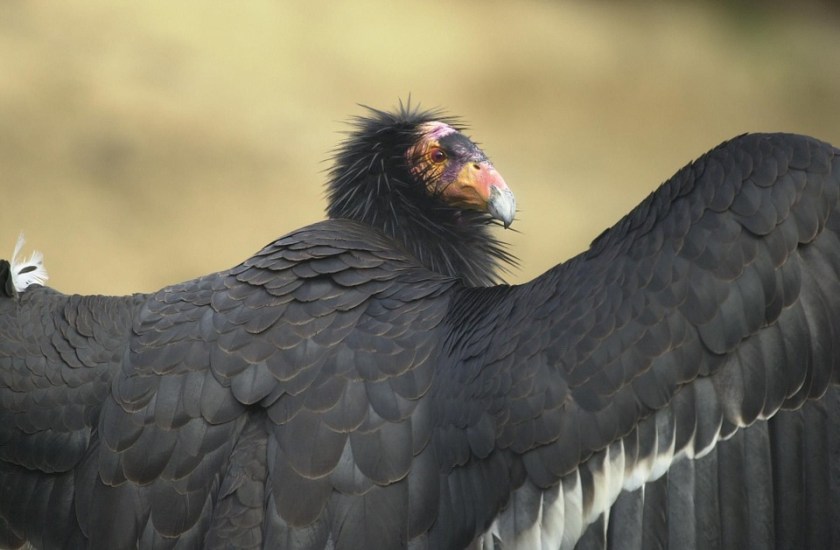
Uncertainty, difference, and deconstruction belong to Derrida’s philosophy and are employed by Cary Wolfe to shift from a mind-set of Heideggerian existentialism to new affectivities of ‘extinction’ (pp. 152-153). In Beast and the Sovereign, Vol. II Derrida attends to the poetry of Paul Celan (‘The world is gone, I must carry you.’) and the trope of the sacrificial lamb as that which establishes the killing but also the letting-die of the non-human world. What follows is a theoretical expansion of the artists’ photographic installation on the California Condor. It should be noted that Sigurjónsdóttir also reflects on this. By highlighting the aesthetic austerity of the post-mortem portraits of condors exposed to lead poisoning alongside the eulogy-like testimonials of their handlers, she argues an ‘individualized necrology’ that offsets the broader layout of video works, a curatorial decision that contests that same anthropocentric drive to authenticate the real through journalistic modes of documentation (pp. 68-69).
Wolfe makes similar observations, but importantly insists that while the photographs are indeed ‘funereal’, they are also imbued with a ‘radical alterity’ that comprises the unknowability of death along with the withdrawing ontology of the animal ‘other’ (p. 159). In an almost Levinasian vein, he argues that the work reminds us of a general lack of assurances (i.e. a surplus of alterity) that in turn forms a ‘scene of ethical responsibility’ (p. 160) informed by a dialectic of environmental interiority and exteriority that is effectively explored via Alva Noë’s claim for a plurality of structured worlds or ecosystems per sensorial inhabitant (pp. 161-162).
Fourteen colour plates of individual birds are accompanied by their ‘obituaries’, illustrating the archive as a ‘stabilizing apparatus’ successfully interrogated through an underscoring of that very same unifying principle of ecological non-knowledge, or, what Derrida refers to as an ‘adestination’ for scientific knowhow (p. 166). Ultimately, it is Wolfe’s understanding of ‘hauntology’ that begins to connect with emerging discourses for eco-theory, purposefully departing from any ontological approach to what can now be undoubtedly recognized as our ‘critical environments’, through which we all must bear a burden.
You Must Carry Me Now is not only an elegantly constructed book, but also a timely and terribly important publication. The pervasiveness of the Anthropocene within the discourses of visual cultures, sociology, human geography, biology and other fields is gaining ground, largely due to its unavoidability. The environmental humanities are rightfully engaging with other disciplines and providing necessary challenges for thinking philosophical, artistic and curatorial practices in more lateral ways. Snæbjörnsdóttir and Wilson have achieved a remarkable feat with this project, not least because of its ability to map and manifest the urgencies of our contemporary moment; without narrating the fate of two endangered species, the artists have successfully transmogrified animal-human relations to land and home.
[1] See Hannah Arendt, ‘(True) Being and (Mere) Appearance’, in The Life of the Mind (London: Harcourt Brace Jovanovich, 1981).
[2] Timothy Morton, The Ecological Thought (London: Harvard University Press, 2010), 40.
 CONCEPTUAL ECOLOGIES